
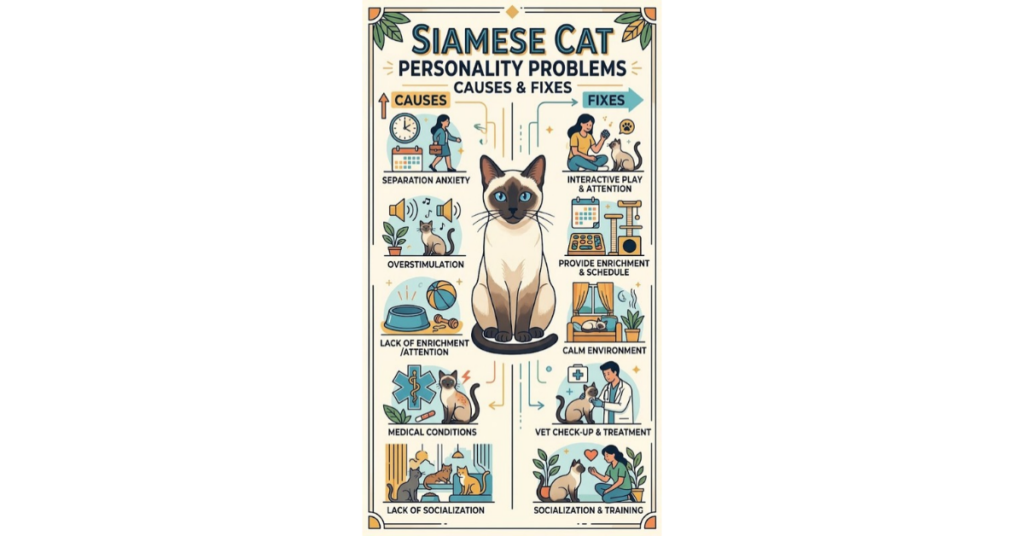
Siamese cats are famous for their striking blue eyes, sleek coats, intelligence, and unusually expressive personalities. They can be affectionate companions who follow their owners around the house, but their strong social needs and energetic nature can sometimes create challenges. Understanding Siamese cat personality problems can help you distinguish normal breed characteristics from behaviors that need attention.
Some Siamese cats become extremely vocal, demand constant interaction, scratch furniture, or struggle when left alone. Others may show aggression toward unfamiliar animals or become anxious when their routine changes. These behaviors do not mean a Siamese cat is naturally bad-tempered. More often, they reflect unmet needs, stress, individual temperament, or an underlying health issue.
This guide explores the most common behavioral challenges in Siamese cats, why they happen, and what you can do to encourage calmer, healthier behavior.
What Are the Most Common Siamese Cat Personality Problems?
Siamese cats are generally intelligent, active, and people-oriented. Although individual personalities vary, many enjoy interactive play, social contact, and regular mental stimulation.
Their most common behavioral challenges include:
- Excessive meowing and demanding vocalizations
- Clinginess and attention-seeking behavior
- Separation-related distress
- Boredom and destructive behavior
- Aggression toward people or other pets
- Jealousy-like behavior around attention and resources
- Anxiety caused by environmental changes
- Difficulty accepting unfamiliar animals or visitors
Not every Siamese cat will display these behaviors. Genetics, early socialization, health, age, living conditions, and past experiences all influence how a cat behaves.
1. Excessive Meowing and Loud Vocalization
<text>One of the most recognizable Siamese cat personality traits is its loud, distinctive voice. These cats often communicate through meows, chirps, trills, and other sounds, sometimes appearing to hold entire conversations with their owners.</text>
<text>Frequent vocalization is not automatically a behavioral problem. It becomes challenging when a cat meows persistently throughout the night, demands attention every few minutes, or vocalizes in ways that interfere with sleep and daily routines.</text>
Why Do Siamese Cats Meow So Much?
Several factors may explain excessive meowing:
- Attention seeking: Your cat has learned that vocalizing brings interaction.
- Hunger: Meowing may become a way to request food or treats.
- Boredom: An under-stimulated cat may vocalize to create activity.
- Stress: Changes in the household can increase vocal behavior.
- Medical problems: Pain, thyroid disease, hearing changes, or other conditions can cause increased vocalization, particularly in older cats.
How to Manage Excessive Meowing
Start by checking that your cat’s basic needs are met. Keep feeding times predictable, provide daily interactive play, and make sure fresh water, clean litter boxes, and comfortable resting places are available.
Reward quiet, relaxed behavior with attention rather than responding to every demand immediately. Avoid shouting or punishing your cat, as this can increase stress without addressing the underlying reason for the behavior.
If the meowing begins suddenly, becomes unusually intense, or occurs alongside changes in appetite, weight, sleep, or litter-box habits, arrange a veterinary examination.
2. Clinginess and Constant Attention-Seeking
Siamese cats often form strong bonds with their owners. They may follow people from room to room, sit beside them while they work, or insist on being involved in everyday activities.
This affectionate nature can be wonderful, but it may become difficult when a cat struggles to settle independently or repeatedly interrupts work, sleep, and other responsibilities.
Why Is My Siamese Cat So Clingy?
A Siamese cat may seek constant attention because of its social temperament, insufficient enrichment, a recent household change, or a learned pattern of interaction.
For example, if a cat receives a treat or extended attention every time it paws at an owner, it may repeat that behavior more frequently. Clinginess can also increase when a familiar person returns after a long absence.
How to Encourage Healthy Independence
You do not need to make your cat less affectionate. Instead, help it feel comfortable spending time alone.
- Provide comfortable beds or resting spots in several rooms.
- Offer puzzle feeders and toys that encourage independent activity.
- Schedule short, regular play sessions throughout the day.
- Reward your cat for settling quietly on its own.
- Give attention at predictable times instead of responding to every demand.
The goal is to create a balance between companionship and independence, not to discourage bonding.
3. Separation Anxiety and Distress When Left Alone
Because Siamese cats can be strongly attached to their human companions, some struggle when left alone for extended periods. However, it is important to distinguish ordinary boredom or calling from genuine separation-related distress.
Possible warning signs include persistent vocalization after an owner leaves, pacing, destruction near doors, inappropriate elimination, reduced appetite, or unusually intense behavior when the owner returns.
These signs can have other causes, so they should not automatically be attributed to separation anxiety.
How to Help a Siamese Cat Cope With Being Alone
Begin by making departures and returns calm and predictable. Provide food puzzles, safe toys, climbing spaces, and comfortable resting areas before leaving.
If your cat becomes distressed during short absences, gradually practice brief periods apart and increase the duration only when the cat remains comfortable. A camera can sometimes help you determine whether the behavior happens only when nobody is home.
A companion animal may help some cats, but getting another cat is not a guaranteed solution. Introductions can create additional stress, particularly when the animals have incompatible personalities.
If the distress is severe or persistent, consult a veterinarian or qualified feline behavior professional. Do not punish accidents or destructive behavior that occurs while you are away.
4. Destructive Scratching and Furniture Damage
Siamese cats are energetic and curious. Without suitable outlets for their natural behaviors, they may scratch sofas, climb curtains, knock objects off shelves, or explore places their owners would prefer them to avoid.
Scratching is a normal feline behavior used for claw maintenance, stretching, scent marking, and communication. The solution is to provide appropriate places to scratch rather than trying to eliminate the behavior completely.
Why Does a Siamese Cat Become Destructive?
Common reasons include:
- Insufficient physical activity
- Lack of environmental enrichment
- A need to climb, explore, or scratch
- Stress caused by changes in the home
- Attention-seeking behavior
- Inadequate access to appropriate scratching surfaces
Practical Ways to Prevent Destructive Behavior
Provide sturdy scratching posts and horizontal scratching pads in areas your cat already uses. Some cats prefer sisal, while others like cardboard or carpet-like textures, so offering different options can help.
Cat trees, window perches, climbing shelves, and interactive toys provide additional outlets for energy. Rotate toys periodically to maintain interest, and reward your cat when it uses appropriate scratching surfaces.
Avoid physical punishment, declawing as a routine solution, or frightening deterrents. These approaches may increase stress or create additional welfare problems.
5. Aggression Toward Owners or Other Pets
Aggression is one of the more concerning Siamese cat personality problems, especially when it involves repeated biting, scratching, or attacks on other household animals.
However, aggression is a description of behavior, not a diagnosis. Understanding what triggers it is essential before choosing a solution.
Common Types of Siamese Cat Aggression
Play aggression: A young or under-stimulated cat may chase feet, grab hands, or bite during play. This often reflects hunting behavior rather than genuine hostility.
Fear-based aggression: A frightened cat may hiss, growl, swat, or bite when it feels trapped or threatened.
Pet-related conflict: Competition over food, resting places, litter boxes, or human attention can create tension between cats.
Redirected aggression: A cat that becomes highly aroused by something it cannot reach, such as an unfamiliar cat outside a window, may attack a nearby person or animal.
Pain-related aggression: A cat that suddenly resists being touched or becomes unusually irritable may be experiencing pain or illness.
How to Reduce Aggressive Behavior
First, identify the trigger. Notice what happens immediately before the aggression, including handling, feeding, play, loud noises, or encounters with other animals.
Use wand toys rather than your hands or feet during play. Provide separate food bowls, water stations, resting areas, and litter boxes for cats living together. A commonly recommended starting point is one litter box per cat plus one extra, placed in accessible locations.
Never force cats to interact or punish them for growling and hissing. If conflict occurs, separate the animals safely and allow them to calm down before attempting gradual reintroduction.
Sudden aggression, severe biting, or repeated attacks warrant veterinary advice. If a medical cause is ruled out, a feline behavior professional can help develop a safe management plan.
6. Jealousy-Like Behavior and Possessiveness
Some Siamese cats appear jealous when their owners interact with another pet, a visitor, or even a phone or laptop. A cat might push between two people, interrupt a cuddle session, vocalize when another animal receives attention, or compete for a preferred resting spot.
Although people often describe this as jealousy, the behavior may be better explained by social competition, frustration, learned attention-seeking, or concern about access to valued resources.
How to Handle Attention-Seeking Around Other Pets
Make sure each animal has access to essential resources without having to compete. Give your Siamese cat individual playtime and attention, and reward calm behavior when another pet is nearby.
Avoid forcing equal interaction at every moment. Instead, establish predictable routines so your cat can learn that another animal receiving attention does not mean its own needs will be ignored.
If conflict develops between pets, focus on reducing competition and creating safe spaces rather than treating the behavior as a personality flaw.
7. Boredom, Hyperactivity, and Constant Mischief
Siamese cats are often playful and mentally active. Some retain kitten-like energy well into adulthood, particularly when their environment offers few opportunities for exploration and problem-solving.
A bored cat may race through the house at night, repeatedly knock items off furniture, pounce on moving feet, or demand play when its owner is trying to relax.
These behaviors are not necessarily signs of a problem. Normal bursts of activity are common in cats, but persistent restlessness may indicate that the cat’s daily routine needs adjustment.
How to Keep an Active Siamese Cat Entertained
Try a combination of physical exercise and mental stimulation:
- Interactive play: Use wand toys to encourage chasing, stalking, and pouncing.
- Puzzle feeding: Make some meals more engaging with food puzzles or treat-dispensing toys.
- Vertical space: Add stable cat trees, shelves, or window perches.
- Toy rotation: Store some toys away and bring them back periodically.
- Short play sessions: Schedule several sessions rather than relying on one long session.
- Predictable routines: Offer play, food, and rest at reasonably consistent times.
A play session followed by a meal can suit many cats’ natural activity patterns. Adjust the schedule to your cat’s age, health, preferences, and energy level.
If restlessness develops suddenly, particularly in a senior cat, seek veterinary advice instead of assuming the cause is boredom.
8. Anxiety and Sensitivity to Environmental Changes
Some Siamese cats react strongly to unfamiliar visitors, moving house, new furniture, construction noise, or changes in their owners’ schedules.
Signs of stress can include hiding, excessive grooming, reduced appetite, increased vocalization, urine marking, or avoiding the litter box. These symptoms may also indicate medical problems, so persistent changes deserve attention.
How to Make Your Siamese Cat Feel More Secure
Maintain familiar feeding and play routines whenever possible. Provide hiding places, elevated resting areas, and quiet spaces where the cat can retreat without being disturbed.
When introducing new people, pets, or household changes, allow the cat to approach at its own pace. Avoid pulling it out of hiding or forcing contact.
For major changes, preserve familiar bedding and objects that carry familiar scents. If stress continues despite environmental adjustments, a veterinarian can assess whether medical treatment or behavioral support may be appropriate.
9. Siamese Cats and Nighttime Activity
Some owners find that their Siamese cats become especially active when the household is quiet. Nighttime meowing, running, jumping on beds, and waking people for attention can make sleep difficult.
Cats naturally distribute activity across different periods of the day and night. An indoor cat that sleeps for much of the day may have plenty of energy left when its owner is ready for bed.
How to Establish a Better Nighttime Routine
- Schedule interactive play in the evening.
- Offer an appropriate meal after play, if consistent with the cat’s feeding plan.
- Provide stimulating daytime activities.
- Keep bedroom access and nighttime responses consistent.
- Avoid rewarding repeated nighttime demands with exciting play or treats.
Do not withhold necessary food, water, or litter access to discourage nighttime behavior. If an older cat suddenly starts crying at night, a veterinary examination is particularly important because pain, sensory changes, cognitive dysfunction, and other medical conditions may be involved.
Are Siamese Cats More Difficult Than Other Cats?
Siamese cats are not inherently bad pets or more aggressive than all other breeds. They are often described as sociable, vocal, intelligent, and active, characteristics that may be rewarding for owners who enjoy an interactive companion.
Those same traits can feel demanding in a household that has limited time for play or prefers a quiet, independent pet. However, individual cats differ considerably, and breed alone cannot predict a particular animal’s behavior.
| Characteristic | Potential Challenge | Helpful Approach |
| Vocal communication | Frequent meowing | Predictable routines and appropriate responses |
| Strong social interest | Clinginess | Enrichment and gradual independence |
| High activity levels | Mischief or nighttime activity | Interactive play and climbing opportunities |
| Intelligence and curiosity | Boredom | Puzzle toys and environmental variety |
| Sensitivity to change | Stress-related behavior | Safe spaces and gradual transitions |
A Siamese cat may be an excellent match for someone who enjoys daily interaction and has time to meet its needs. The important question is not whether the breed has personality problems, but whether its individual temperament and requirements fit your household.
How to Train a Siamese Cat and Improve Its Behavior
Siamese cats can learn routines and behaviors through consistent, reward-based training. Their intelligence can make training engaging, but progress depends on motivation, patience, and the individual cat.
Use these basic principles:
- Reward desired behavior: Offer small treats, praise, or play when your cat does something you want to encourage.
- Keep training sessions short: A few minutes at a time is often more effective than a long session.
- Make the environment easier to navigate: Place scratching posts, litter boxes, and resting spots where your cat can use them comfortably.
- Avoid punishment: Shouting, hitting, spraying water, or frightening a cat can increase fear and damage trust.
- Stay consistent: Everyone in the household should follow the same basic rules.
- Track patterns: Keep a simple record of triggers, times, and changes in behavior to help identify what is working.
Training is not about suppressing a cat’s personality. It is about teaching acceptable alternatives and making it easier for the cat to meet its needs safely.
When Should You Worry About Siamese Cat Personality Problems?
Not every unwanted behavior requires professional treatment, but certain changes should never be dismissed as typical Siamese behavior.
Contact a veterinarian if your cat develops:
- Sudden aggression or unusual irritability
- A major increase in vocalization
- Loss of appetite or unexplained weight changes
- Urinating outside the litter box
- Persistent hiding or withdrawal
- Excessive grooming or visible skin damage
- Disorientation or unusual nighttime crying
- A sudden change in activity, sleep, or social behavior
Medical conditions can cause behaviors that look like emotional or personality problems. A veterinary examination should generally come before assuming the cause is psychological.
Seek urgent veterinary care if your cat repeatedly strains to urinate, produces little or no urine, or appears unable to urinate. Urinary obstruction is a life-threatening emergency, particularly in male cats.
For persistent behavior issues after medical causes have been considered, a veterinarian or qualified feline behaviorist can help identify triggers and recommend a tailored plan.
Frequently Asked Questions
1. Do Siamese cats have behavior problems?
Some Siamese cats develop behavioral challenges such as excessive vocalization, clinginess, boredom, or aggression. These behaviors are not inevitable and often improve when their social, environmental, and health needs are addressed.
2. Why are Siamese cats so needy?
Siamese cats are often highly social and enjoy interacting with their owners. A cat that constantly demands attention may also be bored, stressed, or responding to a learned pattern in which vocalizing or pawing reliably gets a reaction.
3. Are Siamese cats aggressive?
Siamese cats are not inherently aggressive. Biting, scratching, or fighting may result from fear, overstimulation, play behavior, resource competition, or pain, so identifying the trigger is essential.
4. Do Siamese cats suffer from separation anxiety?
Some Siamese cats experience separation-related distress because of their strong social bonds, but not every vocal or clingy cat has separation anxiety. Persistent distress during absences should be assessed carefully, with veterinary guidance when needed.
5. Why does my Siamese cat meow constantly?
Frequent meowing may reflect the breed’s vocal nature, hunger, boredom, attention-seeking, or stress. A sudden or unusual increase in vocalization can also indicate illness or pain and should be checked by a veterinarian.
6. Are Siamese cats good for first-time owners?
They can be, provided the owner understands their need for interaction, play, enrichment, and routine veterinary care. First-time owners should be prepared for a potentially vocal and socially demanding companion.
7. Do Siamese cats get jealous of other pets?
They may compete for attention or valued resources, which can look like jealousy. Separate feeding areas, multiple resting places, gradual introductions, and positive reinforcement can reduce tension between household animals.
8. How can I calm down my Siamese cat?
Start by providing predictable routines, daily interactive play, hiding places, climbing opportunities, and reward-based training. If the behavior is new, intense, or persistent, ask a veterinarian to rule out health problems before treating it as a behavioral issue.
9. Do Siamese cats become calmer with age?
Many cats become less physically active as they mature, but individual personalities vary. Adult and senior Siamese cats can remain vocal and affectionate, and a sudden change in activity or temperament should not automatically be attributed to aging.
Conclusion
Understanding Siamese cat personality problems starts with recognizing that many challenging behaviors are connected to the breed’s social, active, and communicative nature. Excessive meowing, clinginess, destructive scratching, nighttime activity, and aggression can have several causes, and the right solution depends on the individual cat.
Consistent routines, interactive play, environmental enrichment, reward-based training, and appropriate social interaction can make everyday life easier for both cats and owners. Just as importantly, sudden or persistent behavioral changes deserve veterinary attention because pain and illness can sometimes be responsible.
With patience and a better understanding of feline behavior, you can help your Siamese cat feel secure, stay mentally stimulated, and build a stronger relationship with your household. If you’re considering adopting one, learn about the breed’s care needs and temperament before making a decision so you can provide the right long-term environment.