
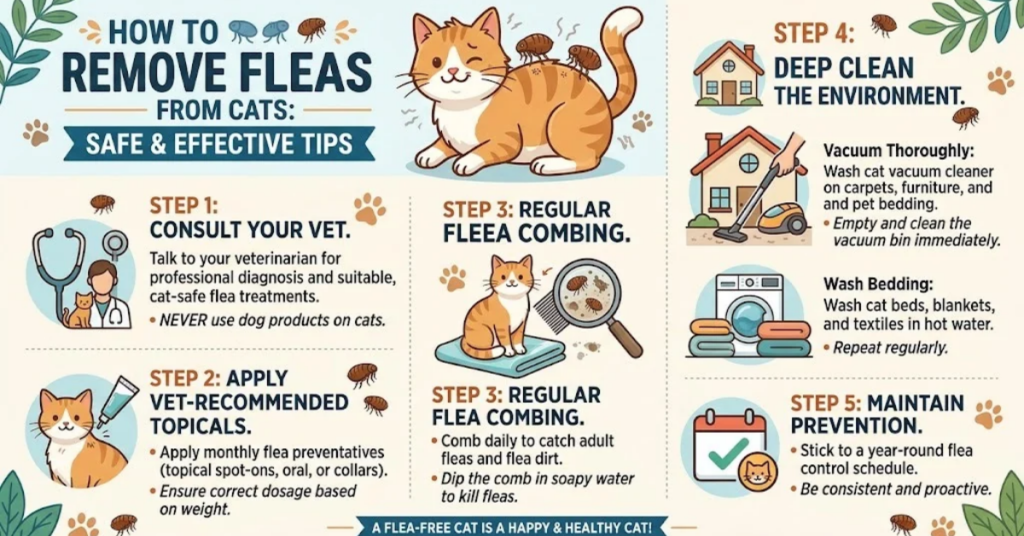
Finding fleas on your cat can be frustrating, especially when your pet won’t stop scratching, licking, or biting its skin. These tiny parasites multiply quickly, and a few fleas can soon turn into a much bigger problem. Knowing how to remove fleas from cats is essential for keeping your pet comfortable, healthy, and free from irritating bites.
Fortunately, getting rid of fleas is possible with the right combination of veterinary-approved treatments, regular grooming, and thorough home cleaning. However, simply removing the fleas you can see isn’t enough. Flea eggs, larvae, and pupae may remain hidden in carpets, bedding, furniture, and other areas where your cat spends time.
This guide explains how to identify a flea infestation, choose safe treatments, remove fleas from your cat, clean your home, and prevent the parasites from returning.
How to Tell If Your Cat Has Fleas
Before choosing a flea treatment, make sure your cat actually has fleas. These small, reddish-brown insects move quickly through the fur and are often difficult to spot, particularly in cats with thick or dark coats.
Some cats react strongly to flea bites, while others show very few visible symptoms. Even a small number of fleas can cause significant discomfort in sensitive animals.
Common Signs of Fleas in Cats
Look for the following symptoms:
- Frequent scratching: Your cat may repeatedly scratch around its neck, ears, back, and tail.
- Excessive grooming: Cats often lick, chew, or bite their fur to relieve itching.
- Hair loss: Repeated scratching and biting can create thin or bald patches.
- Red or irritated skin: Flea bites may cause small bumps, inflammation, and scabs.
- Restlessness: An uncomfortable cat may become unusually restless or have difficulty sleeping.
- Visible fleas: You might notice tiny brown insects moving through the fur.
- Flea dirt: Small black or dark-brown particles may appear on your cat’s skin or bedding.
How to Identify Flea Dirt
Flea dirt is one of the easiest ways to detect an infestation when you cannot find live fleas.
It consists of flea droppings containing digested blood. To check for it:
- Place your cat on a light-colored towel.
- Use a fine-toothed flea comb to brush through the fur, particularly around the neck and base of the tail.
- Collect any black particles that appear.
- Place them on a damp white paper towel.
- Look for reddish-brown streaks.
If the particles dissolve into reddish-brown marks, they may be flea dirt. Ordinary dirt generally does not produce the same rusty-red appearance.
How to Remove Fleas from Cats Safely
The most effective way to eliminate fleas is to combine a suitable flea treatment with physical removal and environmental cleaning.
Here are the steps to follow.
1. Use a Veterinary-Approved Flea Treatment
A veterinarian-approved flea treatment is generally the most reliable way to kill fleas and control an infestation.
Depending on your cat’s age, weight, health, and lifestyle, your veterinarian may recommend:
- Topical flea treatments: Liquid medications applied directly to the skin, usually at the back of the neck.
- Oral flea medications: Tablets or chewable products that kill fleas after administration.
- Flea collars: Specially designed collars that provide ongoing flea protection.
- Prescription treatments: Products selected by a veterinarian for cats with recurring or severe infestations.
Different products work in different ways. Some kill adult fleas, while others also interfere with flea development or provide longer-lasting protection.
Always follow the product label and veterinary instructions. Never use a dog flea treatment on a cat unless a veterinarian specifically confirms that the product is safe for that animal.
Important safety warning: Some dog flea products contain permethrin, an insecticide that is highly toxic to cats. Exposure can cause tremors, seizures, and potentially life-threatening poisoning. Keep cats away from recently treated dogs until the product label or veterinarian confirms it is safe.
2. Comb Your Cat With a Fine-Toothed Flea Comb
A flea comb helps remove adult fleas, flea dirt, and loose debris from your cat’s coat. It is particularly useful for kittens and cats that need gentle physical grooming.
Follow these steps:
- Choose a quiet place where your cat feels comfortable.
- Place a white towel beneath your pet to catch fleas and debris.
- Gently comb the fur, starting around the head and neck.
- Continue along the back, belly, legs, and base of the tail.
- Dip the comb into a container of soapy water after each pass to trap removed fleas.
- Repeat the process regularly, as tolerated by your cat.
Be gentle around irritated skin, scabs, and sensitive areas. A flea comb can help reduce the number of adult fleas, but it cannot eliminate an infestation on its own.
3. Bathe Your Cat Only When Appropriate
A bath may help remove some fleas from a cat’s coat, but it is not usually necessary when an effective veterinary flea medication is being used.
Cats generally dislike bathing, and frequent washing can cause stress or skin irritation. Additionally, bathing too soon after applying a topical flea product may reduce its effectiveness.
If your veterinarian recommends bathing:
- Use a shampoo specifically labeled as safe for cats.
- Follow the product’s age and weight restrictions.
- Avoid getting shampoo into the eyes, ears, nose, and mouth.
- Rinse thoroughly to remove all product residue.
- Dry your cat gently and keep it warm.
Avoid ordinary human shampoo, essential oil shampoos, and dog flea shampoos. Some ingredients used in products for other animals can be dangerous to cats.
4. Treat All Household Pets
If you have multiple pets, treating only the cat with visible fleas may not solve the problem.
Dogs, cats, and other suitable household hosts can help fleas survive and reproduce. Untreated animals may allow the infestation to continue.
A better approach is to:
- Check every household pet for fleas.
- Ask your veterinarian which flea products are appropriate for each animal.
- Treat each pet according to its species, age, and weight.
- Follow the recommended treatment schedule.
- Keep treated animals separated when necessary to prevent accidental exposure to medications.
Never assume that a flea treatment suitable for dogs is also safe for cats.
How to Get Rid of Fleas in Your Home
Treating your cat is only part of the process. Fleas spend much of their life cycle outside the animal, particularly in carpets, bedding, furniture, and cracks in flooring.
Adult fleas live on animals, but their eggs can fall into the surrounding environment. These eggs develop into larvae and pupae before emerging as adult fleas.
This is why a cat may continue to encounter fleas even after receiving treatment.
1. Vacuum Carpets and Upholstery Regularly
Vacuuming helps remove flea eggs, larvae, adult fleas, and organic debris that developing fleas feed on.
Focus on areas where your cat spends the most time, including:
- Carpets and rugs
- Sofas and upholstered furniture
- Under beds and furniture
- Carpet edges and corners
- Floor cracks and crevices
- Pet sleeping areas
Vacuum thoroughly and frequently during an infestation. Empty the vacuum container outdoors or dispose of the vacuum bag securely after cleaning, following the manufacturer’s instructions.
2. Wash Your Cat’s Bedding
Your cat’s bed, blankets, washable toys, and other fabric items can collect flea eggs and debris.
To clean them effectively:
- Remove bedding and washable fabrics from your cat’s favorite resting areas.
- Wash them using detergent and the hottest water temperature the fabric safely allows.
- Dry them thoroughly using an appropriate dryer setting.
- Repeat regularly while treating the infestation.
If an item cannot be cleaned effectively, consider replacing it.
3. Clean Furniture and Hidden Areas
Fleas and their immature stages can hide in places that are easy to overlook.
Pay particular attention to:
- Furniture seams and cushions
- Spaces beneath sofas
- Pet carriers
- Cat trees and scratching posts
- Curtains and fabric-covered furniture
- Areas where your cat regularly sleeps
Vacuuming and washing removable materials are useful first steps. For persistent infestations, ask a pest-control professional about products that are safe to use in homes with cats.
4. Consider Professional Pest Control
A severe flea infestation may require professional treatment, particularly when fleas continue appearing despite consistent cleaning and veterinary treatment.
Tell the pest-control company that you have cats. Ask which products will be used, how long pets must remain outside treated areas, and when it is safe for them to return.
Never allow your cat to walk on wet insecticide-treated surfaces or enter an area before the specified re-entry period has passed.
Natural Ways to Remove Fleas from Cats: What Works?
Many pet owners prefer natural flea remedies because they seem gentler than chemical products. However, natural does not automatically mean safe or effective.
Some home remedies can irritate a cat’s skin or cause poisoning, particularly when concentrated oils or inappropriate substances are used.
Are Flea Combs Effective?
Yes. Flea combs can physically remove adult fleas and flea dirt from your cat’s fur.
They are a useful addition to a flea-control routine, especially for kittens that are too young for certain medications. However, they do not reliably eliminate eggs, larvae, or pupae in the environment.
Does Dish Soap Kill Fleas?
Dish soap may kill or immobilize some adult fleas during bathing, but it does not provide reliable long-term flea protection.
Repeated use can also dry or irritate a cat’s skin. It should not replace a veterinary-approved flea treatment.
Is Apple Cider Vinegar Effective Against Fleas?
There is no good scientific evidence that apple cider vinegar reliably eliminates fleas from cats.
Applying it to irritated skin can cause discomfort, and putting vinegar into your cat’s food or water is not a proven flea-control method.
Are Essential Oils Safe for Cats?
Many essential oils can be harmful to cats, particularly when concentrated or applied directly to their skin.
Avoid using products containing oils such as tea tree, peppermint, eucalyptus, and pennyroyal as flea treatments unless a veterinarian specifically confirms the safety of a particular product.
Cats have different abilities to metabolize certain compounds, so remedies that are marketed as natural flea repellents can still cause serious health problems.
How to Remove Fleas from Kittens
Kittens require extra care because their small bodies and developing systems make them more vulnerable to certain flea treatments and the effects of blood loss.
A heavy flea infestation can cause anemia, which may become life-threatening in very young kittens.
Safe Flea Removal for Young Kittens
If you notice fleas on a kitten:
- Contact a veterinarian to determine which treatments are appropriate for its age and weight.
- Use a fine-toothed flea comb to remove adult fleas gently.
- Dip the comb in soapy water to trap the fleas.
- Keep the kitten warm and comfortable.
- Wash its bedding and clean the surrounding area.
- Follow veterinary instructions for ongoing flea prevention.
Some flea medications are approved only for kittens above a particular age or weight. Never assume that a product suitable for an adult cat is safe for a young kitten.
Seek urgent veterinary care if a kitten has pale gums, weakness, unusual sleepiness, rapid breathing, or difficulty feeding. These can be signs of anemia or other serious problems.
How Long Does It Take to Get Rid of Fleas on Cats?
The time required depends on the severity of the infestation, the treatment used, and how thoroughly the home environment is cleaned.
An effective flea medication may begin killing adult fleas within hours, depending on the active ingredient. However, eliminating an established household infestation can take several weeks or longer.
The reason is the flea life cycle:
- Eggs: Flea eggs fall from the animal into the environment.
- Larvae: Eggs hatch into larvae that develop in protected areas.
- Pupae: Larvae form cocoons, where fleas develop into adults.
- Adult fleas: Mature fleas emerge and seek an animal host.
Flea pupae are particularly difficult to eliminate because their cocoons protect them from many environmental treatments. New adult fleas may therefore continue emerging after the cat has been treated.
Consistent flea prevention, vacuuming, washing bedding, and treating household pets are essential for breaking this cycle.
How to Prevent Fleas from Returning
Once you’ve removed the existing fleas, prevention becomes the next priority. Even indoor cats can develop flea infestations because fleas can enter homes on other animals, people, clothing, or household items.
A consistent prevention routine is more effective than waiting until your cat starts scratching again.
Here are some practical steps:
- Use regular flea prevention: Ask your veterinarian about an appropriate monthly or longer-lasting treatment.
- Check your cat’s coat: Use a flea comb periodically to look for fleas and flea dirt.
- Keep bedding clean: Wash your cat’s blankets and sleeping materials regularly.
- Vacuum frequently: Pay attention to carpets, furniture, and corners.
- Treat all household pets: Ensure every susceptible pet has suitable flea protection.
- Maintain outdoor areas: Keep grass trimmed and remove debris where animals frequently rest.
- Schedule veterinary checkups: Discuss flea prevention during routine health visits.
Remember that flea prevention may be necessary throughout the year, depending on your climate and living environment.
When Should You Take Your Cat to a Veterinarian?
Although many flea infestations can be managed with appropriate treatment, some situations require professional veterinary attention.
Contact your veterinarian if:
- Your cat continues scratching despite flea treatment.
- You notice open wounds, scabs, or significant hair loss.
- Your cat develops severe skin irritation.
- You suspect a flea allergy.
- Your kitten has visible fleas.
- Your cat appears weak, lethargic, or unusually tired.
- You notice pale gums or rapid breathing.
- You suspect your cat has been exposed to a dog flea product containing permethrin.
Flea allergy dermatitis is another condition worth understanding. Some cats are extremely sensitive to proteins in flea saliva, meaning even a small number of bites can trigger intense itching, inflammation, and skin damage.
A veterinarian can diagnose the problem and recommend appropriate treatment for both the fleas and any resulting skin condition.
Frequently Asked Questions About Removing Fleas from Cats
1. What is the fastest way to get rid of fleas on a cat?
The fastest approach is usually a veterinarian-approved flea medication combined with flea combing. Some treatments begin killing adult fleas within hours, but complete control requires addressing fleas and their developing stages in the home.
2. Can I remove fleas from my cat without bathing it?
Yes. Bathing is not essential for flea removal. A fine-toothed flea comb and an appropriate veterinary flea treatment can help eliminate fleas without putting your cat through a stressful bath.
3. Can indoor cats get fleas?
Yes. Indoor cats can get fleas even if they never go outside. Fleas or their eggs can enter the home on clothing, shoes, other pets, or visiting animals.
4. Does salt kill fleas on cats?
Salt is not a recommended flea treatment for cats. Applying it to your pet’s fur or skin can cause irritation, and it does not provide reliable control of an infestation. Use veterinarian-approved products instead.
5. How often should I use a flea comb on my cat?
During an active infestation, you can use a flea comb daily if your cat tolerates it. Regular combing helps identify fleas and remove adult insects, but it should be combined with an effective flea-control product.
6. Can fleas make my cat sick?
Yes. Fleas can cause itching, skin infections, allergic reactions, and, in severe infestations, anemia due to blood loss. Fleas can also transmit tapeworms if a cat swallows an infected flea while grooming.
7. Should I treat my house if my cat has fleas?
Yes. Treating your cat without addressing the surrounding environment may allow the infestation to continue. Vacuum carpets and furniture, wash pet bedding, and consider professional pest control for severe infestations.
8. Can fleas live on humans?
Cat fleas can bite humans, particularly when there are heavily infested pets or animals in the home. However, they generally prefer animal hosts and do not typically establish permanent populations on humans.
Conclusion
Learning how to remove fleas from cats involves more than simply picking insects out of your pet’s fur. The most effective approach combines veterinarian-approved flea medication, regular flea combing, thorough home cleaning, and consistent prevention.
Avoid potentially dangerous home remedies, especially essential oils and flea treatments designed for dogs. Pay particular attention to kittens, older cats, and pets with existing health problems, as they may require specialized care.
With the right treatment and a consistent cleaning routine, you can break the flea life cycle, relieve your cat’s discomfort, and reduce the chances of another infestation. If you’re unsure which flea treatment is suitable for your pet, consult your veterinarian before using a new product.